
Sattva Lumina Masterplan
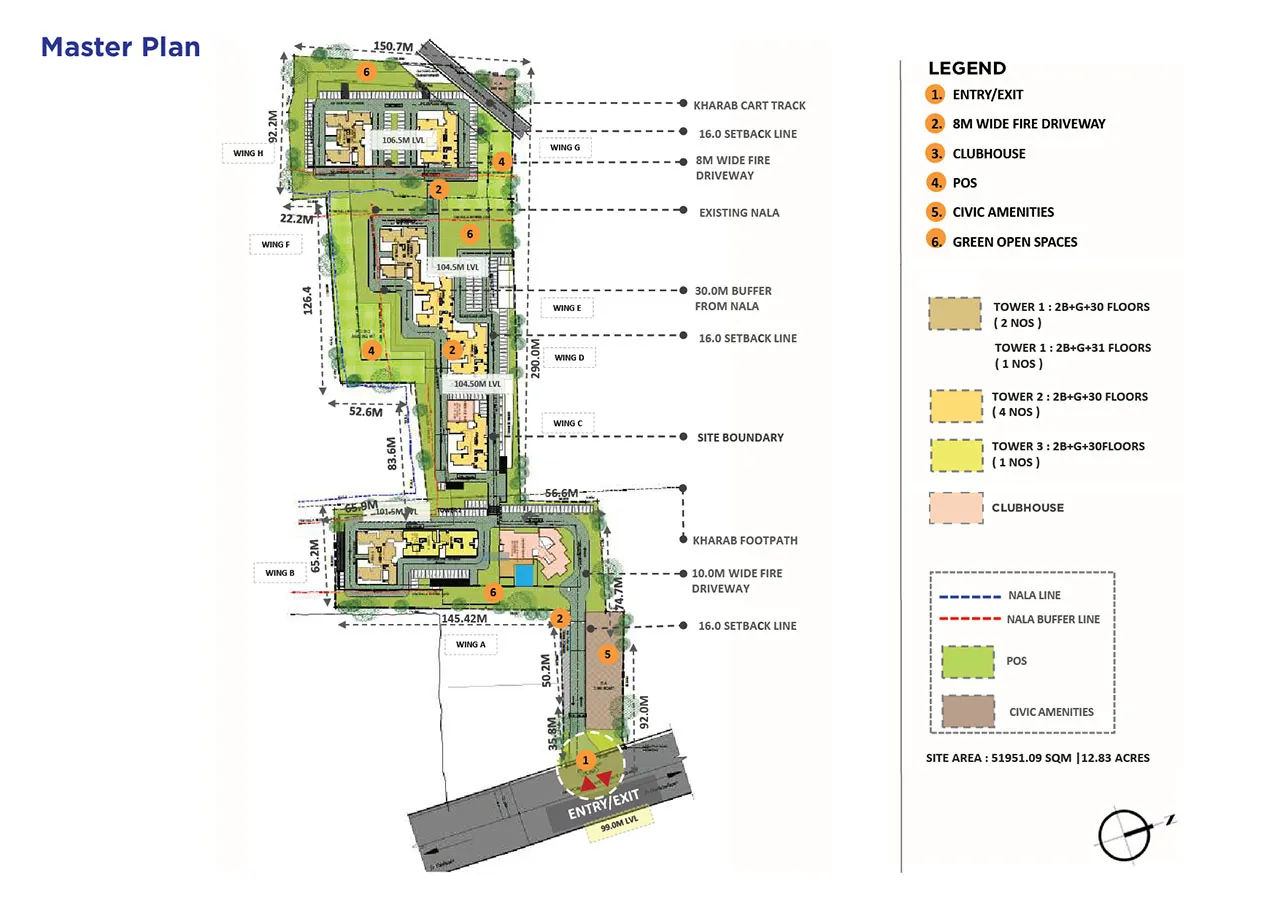
The sanctioned master layout for Sattva Lumina is the document that converts marketing poetry into tower labels, fire-engine loops, and amenity footprints. In this article we read the public master-plan render the way a buyer should: where drop-offs sit relative to children's play noise, how visitor vehicles circulate without cutting residential drop-off queues, and which facings borrow green view versus road view. Pair what you see here with the floor-plan typologies and the amenities inventory so you do not fall in love with a corner unit whose view corridor later hosts a genset bank. For another Bengaluru planning reference, Sattva Mysore Road helps keep attention on density, circulation, landscape depth, and the way residents will move through the community.
Why clusters beat a single long wall
Large parcels often fail when developers line towers along the frontage like a fence, maximising sellable facing but killing internal courtyard depth. Lumina's plan language instead reads as clustered towers around a shared landscape core, which is how you preserve enough distance between slabs for daylight angles that still work on lower middles, not only penthouses. The trade-off is slightly longer internal drive loops for visitors; that is acceptable if fire tender paths stay unblocked and signage is sane at night. Podium parking versus stilt-plus-tower parking changes how heat and noise percolate into lower lobbies-ask which model applies to the tower you shortlist.
Retail podiums-if present-should sit where acoustic separation from bedrooms is achievable through service voids or vertical buffers. If the master plan shows a banquet hall diaphragm immediately under a light-sleeping junior bedroom stack, ask whether acoustic isolation specs were upgraded beyond code minima. Codes are survival thresholds, not comfort guarantees.
STP, ETP, and refuse areas belong at the downwind periphery with service access segregated from the main resident gate. On-site renders sometimes prettify these pads with shrubs; confirm actual chain-link setbacks and odour mitigation stacks in the sanctioned civil drawings, not only the sales PDF.
Swimming pools and deck-level plant rooms interact with tower shadows in ways brochures rarely animate; a north-east pool may feel cold in December while a west-facing splash pad overheats in April unless pergolas are engineered, not sketched. Cricket nets and multi-use courts need ball-stop netting heights that exceed naive landscape mounds, otherwise glass balconies on adjacent towers become accidental wickets. These are fixable details if flagged early; they are expensive lawsuits if ignored.
Clubhouse massing that blocks daylight to mid-level apartments is a classic master-plan failure mode: the hero render shows glass boxes in sunlight, but winter simulations may show permanent shade bands on neighbouring wings. Ask whether any reflective glare off curtain walls affects drivers at the internal roundabout; traffic safety consultants sometimes catch what architects miss.
Open space percentage versus usable open space
Marketing brochures love a single open-space percentage; discerning buyers split that number into walkable lawn, usable sports court, and decorative planter strips you cannot picnic on. Ask sales for a colour-coded CAD layer export if available, or at least a narrative map that labels jogging loop length, kids' cycle track width, and senior citizen seating nodes. A thirteen-acre plate sounds generous until you subtract basement top projections, transformer yards, and mandatory setbacks-then you learn whether your evening walk is three hundred metres or a repetitive lap around a carpark rim.
Tree canopy maturity lags by five to eight years in new townships; budget temporary shade sails or pergolas near pool decks until saplings establish. If the master plan shows wide central lawns, ask irrigation sourcing-treated STP water for landscaping is good practice when executed without smell incidents.
Link your reading to the location chapter because setbacks that look generous on paper may face future road widening notifications from NHAI or state highways; that risk is not Lumina-specific but it is pin-code real.
Dog parks, senior citizen corners, and vegetable co-op kiosks are small programme elements that signal whether the landscape architect thought about daily life or only drone shots. Even if Lumina does not include every micro-amenity, the absence or presence of shaded seating every hundred and fifty metres along the jog loop predicts whether people will actually use the loop or treat it as decoration.
Construction technology and buyer-facing outcomes
Shear-wall–centric RCC frames are standard for mid-rise to high-rise Bengaluru stacks; what changes outcomes is pour quality, curing discipline, and waterproofing at expansion joints. The master plan hints at joint towers or independent cores-verify how movement joints are detailed where wings meet, because that is where monsoon leaks often appear three years post-handover if shop drawings were lazy.
Basement ventilation and CO monitoring plans matter if you intend to use B1/B2 parking daily; long ramps without intermediate exhaust wells cook paint and rubber smells into lobbies above. Fire stair pressurisation and refuge-area sizing should match NBC evolution; older template sales blurbs miss updates.
If Lumina advertises quake-zone compliance beyond zone II defaults, ask for the structural peer-review letter; it is dull reading that saves drama later.
Façade maintenance gondolas and BMU rails sometimes appear only in tender drawings; confirm roof equipment locations so your premium sky unit does not stare at a swinging cradle every morning. Similarly, lift machine rooms and heat rejection paths should not vent toward bedroom decks; master-plan massing hints at adjacencies sales gloss over.
Rainwater harvesting recharge pits need geological suitability in Rajanukunte's hard-strata pockets; generic icons on the plan are insufficient-ask for percolation test summaries if the site is not on a natural high-percolation band.
How to mark up your own master-plan checklist
Print the plan in A3, highlight your shortlisted tower, draw three arrows: morning sun, evening sun, and dominant noise vector toward Doddaballapura Road. Circle STP, transformer, and DG clusters. Mark the distance from tower exit to club entry-two hundred metres feels different with toddlers and swim bags in monsoon. Compare that marked-up sheet against the preferential-location charge grid on your printed cost sheet so you are not paying a view premium for a generator roofline.
If sales cannot reconcile your markup with the latest sanction, pause booking until they can. Master plans are not sentimental; they are legal land-use contracts translated into concrete.
Finally, overlay your own commute arrows: domestic help entry timing, school bus pickup corners, and midnight pharmacy runs. If any of those paths force you through a dark service stretch because the main gate policy is strict after eleven, you want to know now-not after possession handover when security SOPs harden. Photograph the model master plan under neutral lighting, not only under showroom spotlights that flatten depth cues and hide shadow bands.
Need the CAD-accurate legend?
Ask the desk for the latest sanctioned master layout before you freeze a tower and facing.
Sattva Lumina Master Plan - Frequently Asked Questions
The master plan is laid out across roughly thirteen acres at Rajanukunte. Tower counts, height caps, and unit distribution should be verified against the sanctioned drawings rather than published marketing material alone.
Tower-wise phasing is common on parcels of this size. Ask which phase currently sells and whether future phases will share amenities or whether club-access rules differ between phases.
The architecture is expected to follow Sattva's contemporary residential language with landscaped arrival courts, club-centred amenity clustering, and towers arranged to preserve view corridors where the plan allows. Mid-launch refinements happen, so verify current tower labels on the latest sanctioned set.
Within the thirteen-acre envelope, the master plan accounts for clubhouse-led amenity clusters, landscaped open spaces, and internal road circulation. Final dimensions and placement of each block follow the sanctioned plan filed with Karnataka RERA.
Master plans can be refined ahead of formal sanction milestones. Once registered under Karnataka RERA, material changes require statutory consent, so the registered sanction set is the version that legally binds the developer.
Request the master plan exhibit through the contact form along with the brochure pack. The sales data room is the authoritative source for the current sanctioned layout that aligns with the RERA filing.